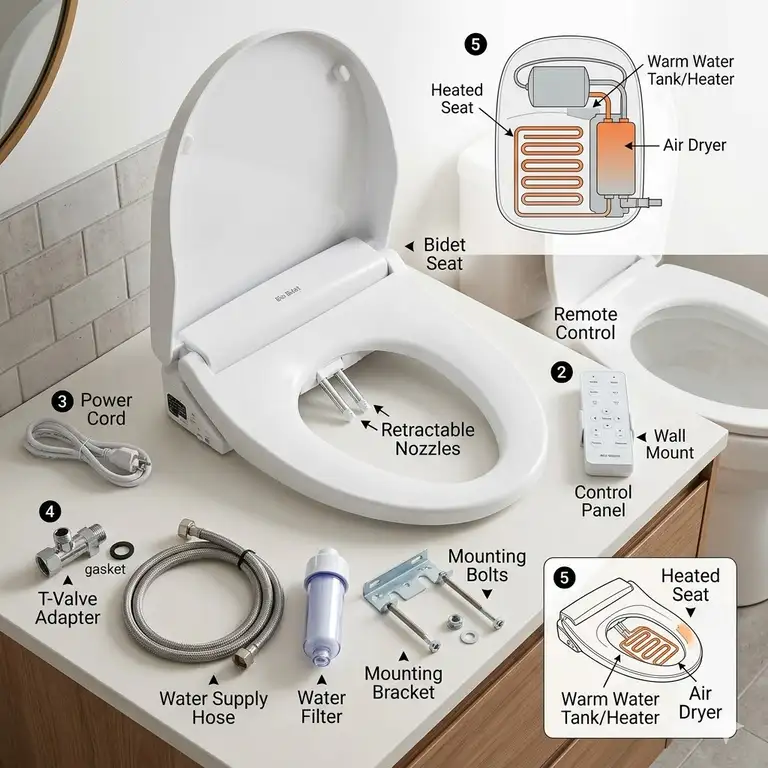
So, you’ve joined the “cleaner side of life” and installed a bidet. Welcome to the club! But as with any plumbing fixture, the honeymoon phase eventually meets the reality of hard water, wear and tear, and the occasional mystery drip. Understanding bidet parts is the difference between a quick five-minute fix and a frantic call to an emergency plumber on a Sunday night.
What is bidet parts? In the simplest terms, bidet parts refers to the individual components—such as T-valves, hoses, mounting brackets, and internal filters—that allow a bidet attachment, seat, or standalone unit to connect to your home’s water supply and function correctly.
In 2026, the market has shifted away from “one-size-fits-all” plastic junk toward durable, specialized components. Whether you are looking to replace a cracked T-adapter or upgrade to a high-efficiency sediment filter, knowing the anatomy of your fixture is vital. According to Wikipedia’s overview of plumbing fixtures, the complexity of these devices has increased significantly with the rise of electronic “washlets,” making it even more important to source the right components for your specific model.
Quick Comparison of Essential Repair Components
| Component Type | Primary Function | Durability Rating | Best For |
| Metal T-Adapter | Diverts water to bidet | High | High-pressure homes |
| Braided Steel Hose | Connects valve to seat | Very High | Preventing leaks |
| Inline Ion Filter | Purifies spray water | Medium | Hard water areas |
| Mounting Bolts | Secures seat to bowl | Medium | Wobbly bidet seats |
| Rubber O-Rings | Seals connections | Low (Replace often) | Stopping minor drips |
Analysis of Component Selection
Looking at the data above, it is clear that while rubber O-rings are the most frequent point of failure, the Metal T-Adapter is the most critical investment for structural integrity. If you live in an older home with fluctuating water pressure, skipping the braided steel hose in favor of a plastic alternative is a recipe for disaster. Budget-conscious users should prioritize the T-adapter first, as a failure there affects the entire toilet’s water supply, not just the bidet.
💬 Just one click — help others make better buying decisions too! 😊
[addtoany]
Top 5 bidet parts: Expert Analysis for 2026
1. Luxe Bidet Heavy Duty Metal T-valve
The Luxe Bidet T-valve is the “gold standard” for those tired of the flimsy plastic adapters that often come in the box with cheaper attachments. This component features a solid brass body and a ceramic-core disk valve.
The inclusion of a ceramic-core disk is a game-changer; unlike rubber washers that compress and degrade over time, ceramic disks provide a smooth, consistent shut-off that lasts for years. In my experience, if your bidet handle feels “mushy” or difficult to turn, the internal valve mechanism is likely failing. Replacing it with a heavy-duty metal version provides a tactile, “click-into-place” feel that prevents accidental leaks. This part is essential for anyone living in high-rise apartments where water pressure can spike unexpectedly.
Customer Feedback Summary: Users consistently praise the “weighty” feel and the fact that it doesn’t cross-thread easily during installation, unlike plastic versions.
-
✅ Solid brass construction prevents cracking
-
✅ Ceramic disk ensures leak-free operation
-
✅ Easy-grip wing nut for tool-free install
-
❌ Slightly heavier, requiring careful alignment
-
❌ May require a wrench for the final 1/4 turn
Price Range: around $15 – $25
Value Verdict: A mandatory upgrade for anyone using a bidet attachment rather than a full seat.
2. TOTO THU9090R Washlet Water Supply Hose
Specifically designed for the TOTO Washlet series, this extension hose is a proprietary but necessary part for those with hidden or difficult-to-reach plumbing connections.
The THU9090R uses high-grade flexible polymer reinforced with a stainless steel mesh. What most buyers overlook about this model is the specific gasket threading. While generic hoses might look like they fit, TOTO’s tolerances are incredibly tight. Using a non-brand hose often leads to a “micro-drip” that you won’t notice until your subfloor is damaged. I recommend this specifically for TOTO owners who are moving their unit to a new bathroom or those who find their current hose is stretched too tight, which can cause internal tension on the washlet’s plastic inlet.
Customer Feedback Summary: Buyers appreciate that it solves the “short hose” problem common in modern bathroom layouts with concealed tanks.
-
✅ Engineered for high-pressure Washlet systems
-
✅ Stainless steel braiding resists kinks
-
✅ Perfect OEM fitment for S300e and S500e models
-
❌ Expensive compared to generic hoses
-
❌ Only compatible with TOTO-specific inlets
Price Range: around $35 – $50
Value Verdict: Don’t risk a $1,000 Washlet on a $5 hose; stick with the OEM part.
3. Brondell Swash Bidet Carbon Ion Filter
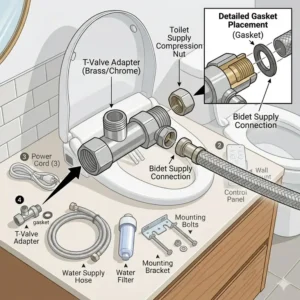
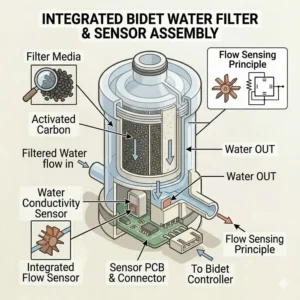
The Brondell Swash filter is an inline component that sits between your water supply and the bidet seat, designed to catch sediment, rust, and chlorine.
Hard water is the silent killer of electronic bidets. The tiny nozzles inside your bidet can easily become clogged with calcium buildup, leading to weak spray or total failure. This carbon ion filter doesn’t just block sand; it chemically reduces the minerals that lead to calcification. From a practical perspective, if you live in a region with “hard” water (like the Southwest US), this filter can double the lifespan of your bidet. The spec sheet says it lasts six months, but if you’re a heavy user, I’d suggest checking it at the four-month mark.
Customer Feedback Summary: Customers in older homes with iron pipes report that this filter turned their “yellowish” spray water crystal clear.
-
✅ Protects internal heating elements from scale
-
✅ Tool-free installation in under two minutes
-
✅ Reduces chlorine odor for a fresher feel
-
❌ Requires regular replacement (recurring cost)
-
❌ Adds about 3 inches of length to your setup
Price Range: around $15 – $20 per filter
Value Verdict: Cheap insurance for expensive electronic bidet seats.
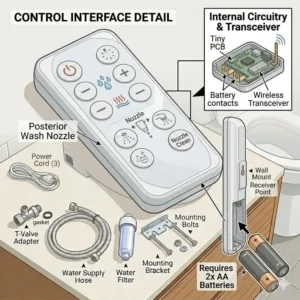
4. Kohler Bidet Seat Mounting Hardware Kit
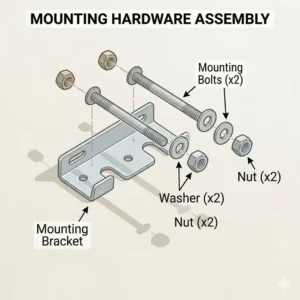
This kit includes the expansion bolts, brackets, and rubber gaskets required to secure a Kohler bidet seat (or many universal brands) to the toilet bowl.
Wobbly seats are the #1 complaint in the bidet world. If the seat shifts when you sit down, it puts lateral pressure on the water connections, which will eventually cause a leak. The Kohler kit uses top-mount expansion bolts. This is a crucial distinction: traditional bottom-nut bolts are almost impossible to tighten on “skirted” toilets where you can’t reach behind the bowl. The expansion bolt allows you to tighten everything from the top with a screwdriver. In my expert opinion, even if your bidet came with hardware, upgrading to these high-friction rubber gaskets provides a much more stable platform.
Customer Feedback Summary: DIYers love that they don’t have to crawl on the floor to tighten the seat anymore.
-
✅ Top-mount design is perfect for skirted toilets
-
✅ High-friction rubber prevents “seat slide”
-
✅ Corrosion-resistant stainless steel bolts
-
❌ Rubber sleeves can be tricky to remove if over-tightened
-
❌ May not fit extremely thin-rimmed porcelain bowls
Price Range: around $10 – $18
Value Verdict: The best $15 you can spend to make your bidet feel “premium” and stable.
5. Bio Bidet Braided Metal Supply Hose (Universal)
This is a 1/2″ to 1/2″ (or 7/8″ adapter compatible) braided metal hose designed to replace the stiff plastic tubes often found in entry-level bidet kits.
The spec sheet highlights the “burst-proof” rating, but what that means for you is peace of mind. Plastic hoses can become brittle over 3-5 years, especially if exposed to sunlight or cleaning chemicals. The Bio Bidet hose uses a multi-layered approach: an inner non-toxic PVC tube encased in a stainless steel web. The spec sheet won’t tell you this, but the flexibility of this hose is its best feature—it allows for tight loops in small bathrooms without kinking. This is the “safe bet” for anyone performing general maintenance on an aging bidet system.
Customer Feedback Summary: Reviewers note that the extra length (usually 16-20 inches) provides enough slack for easy cleaning behind the toilet.
-
✅ Universal fit for most non-electric attachments
-
✅ Kink-resistant braiding
-
✅ Comes with pre-installed rubber washers
-
❌ Can look “industrial” if not tucked away
-
❌ 7/8″ adapter sometimes sold separately
Price Range: around $12 – $20
Value Verdict: A solid, reliable replacement part that exceeds most factory-standard hoses.
✨ Don’t Miss These Exclusive Deals!
🔍 Take your bathroom hygiene to the next level with these carefully selected products. Click on any highlighted item to check current pricing and availability. These tools will help you create authentic results your family will love!
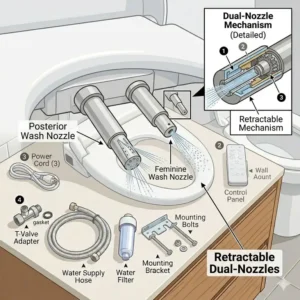
The “Oh No, It’s Leaking” Guide: Troubleshooting bidet parts
Nothing ruins a morning like stepping into a puddle of water in the bathroom. Most bidet leaks aren’t catastrophic failures; they are usually a sign that one specific part has reached its expiration date. Here is how to handle the most common issues without losing your cool.
Identifying the Source
First, wipe everything dry with a paper towel. Then, wrap a dry piece of toilet paper around each connection point (the T-valve, the hose ends, and the seat inlet). Wait five minutes. The damp paper will tell you exactly which bidet parts are failing.
-
Drip at the T-valve: This is usually a worn-out rubber washer or a loose nut. Before buying a new valve, try replacing the internal washer. Over-tightening is a common mistake; it can crush the washer and actually cause a leak.
-
Wetness on the Hose: If the hose itself is damp, it likely has a pinhole leak in the inner lining. Braided hoses can hide these until they burst. Replace the hose immediately.
-
Water Coming from the Seat: This often indicates an internal valve or O-ring failure within the bidet unit itself. If you have an electronic seat, this might be a sign to check your warranty.
The 30-Day Performance Check
After installing new bidet parts, check the connections daily for the first week, then weekly for a month. Fluctuations in home water pressure (especially at night when usage is low) can put extra stress on new seals. A connection that is “dry enough” during the day might weep at 3 AM.
Scenario Analysis: Matching Parts to Your Lifestyle
Choosing the right bidet parts isn’t just about compatibility; it’s about your specific environment. Let’s look at three common user profiles.
The Renter’s “Leave No Trace” Kit
If you are renting an apartment, you want bidet parts that are easy to install and easy to remove without damaging the landlord’s plumbing.
-
The Strategy: Use a high-quality metal T-valve but keep the original toilet parts in a labeled bag under the sink.
-
Why: Plastic T-valves can crack when being removed after two years of use. A metal one ensures you won’t have a plumbing emergency on move-out day.
-
Recommended Part: Luxe Bidet Metal T-valve.
The Hard Water Warrior
If your tea kettle has white crusty stuff inside it, your bidet is in danger. You need a defense-heavy parts strategy.
-
The Strategy: Install an inline ion filter and use a bidet with a “self-cleaning nozzle” feature.
-
Why: Hard water minerals will seize up the internal motors of expensive electronic seats. A $15 filter protects a $400 investment.
-
Recommended Part: Brondell Swash Carbon Ion Filter.
The Modern Minimalist (Skirted Toilets)
If your toilet has flat, smooth sides where you can’t see the bolts, you have a “skirted” toilet. Traditional bidet parts won’t work here.
-
The Strategy: You must use top-mounting hardware.
-
Why: Standard bidet bolts require you to reach under the porcelain to tighten a nut. On skirted toilets, there is no “underneath” to reach.
-
Recommended Part: Kohler Bidet Seat Mounting Hardware.
How to Choose the Right bidet parts: A Buyer’s Checklist
Navigating the world of plumbing can feel like learning a second language. Here is a numbered criteria list to ensure you don’t end up with a box of useless metal.
-
Verify Connection Sizes: Most US toilets use a 7/8″ ballcock thread at the tank. However, the connection to the bidet itself is often 1/2″. Ensure your T-valve matches both.
-
Material Matters: If a part is available in both plastic and brass, choose brass. The cost difference is usually less than $10, but the durability difference is measured in years.
-
Check for “No-Tool” Options: Many modern bidet parts feature “wing nuts” that can be tightened by hand. This is ideal for tight spaces where a wrench won’t fit.
-
Confirm Gasket Presence: Always check if the part comes with rubber gaskets. If not, you’ll need to buy a separate pack of plumbers’ washers or use Teflon tape (though tape is often unnecessary with proper gaskets).
-
Brand Compatibility: While many parts are universal, brands like TOTO and Kohler often use proprietary fittings for their high-end electronic models. Check your manual before buying generic.
Common Mistakes When Buying bidet parts
As an expert who has seen hundreds of DIY bathroom “disasters,” I can tell you that most problems stem from three simple errors.
Mistake #1: Using Plumber’s Putty Instead of Gaskets
Plumber’s putty is great for sink drains, but it has no place on a bidet. The chemicals in some putties can actually degrade the plastic housing of your bidet seat. Always use the provided rubber or silicone gaskets.
Mistake #2: Over-tightening Everything
“Hand-tight plus a quarter turn” is the golden rule. Modern bidet parts rely on rubber seals. If you crank them down with a massive wrench, you will split the gasket or crack the plastic threads on the toilet tank. Once it’s tight, stop. You can always tighten it a tiny bit more if it drips, but you can’t “un-crack” a tank.
Mistake #3: Ignoring the Filter
Many people think the water in their toilet is “clean enough.” While it is the same water that comes out of your tap, the internal components of a bidet are much more delicate than a kitchen faucet. Skipping the filter in a hard-water area is the fastest way to kill an electronic bidet.
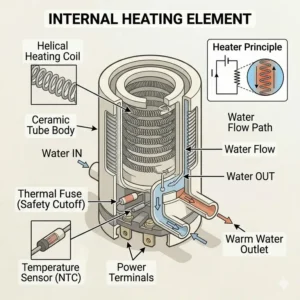
What to Expect: Real-World Performance & Maintenance
The spec sheet says your bidet parts are “maintenance-free,” but that’s marketing hype. In the real world, “maintenance-free” means “it works until it doesn’t.”
For the first six months, you likely won’t notice any change in performance. However, around the one-year mark, you might notice the spray pressure feels a bit weaker. This isn’t usually a pump failure; it’s likely sediment in the T-valve screen or a dirty filter.
Pro Tip: Every six months, turn off the water, disconnect the supply hose, and check the small mesh screen inside the T-valve. You’d be surprised how much “pipe gunk” gets caught there. A quick rinse under the sink can restore your bidet to “like-new” pressure in seconds.
Long-Term Cost & ROI Analysis
Is it worth buying premium bidet parts? Let’s look at the total cost of ownership over five years.
-
The “Budget” Route: Using the plastic parts included in the box.
-
Cost: $0 initially.
-
Risk: High chance of a leak (average water damage deductible is $500 – $1,000).
-
Replacement: Likely need a new $15 hose every 2 years.
-
-
The “Expert” Route: Upgrading to metal T-valves and braided hoses.
-
Cost: ~$40.
-
Risk: Extremely low.
-
Replacement: Parts likely last 10+ years.
-
From an ROI perspective, spending $40 on high-quality bidet parts is the cheapest insurance policy you can buy for your home. It’s not just about the bidet; it’s about protecting your bathroom floor and the ceiling of the room below you.
Features That Actually Matter (And Those That Don’t)
When you’re browsing for bidet parts, you’ll see a lot of buzzwords. Here’s what actually matters:
-
Matters: Ceramic Disk Valves. These are far superior to compression washers. They don’t leak, and they turn smoothly.
-
Matters: Swivel Connections. A hose with a swivel nut on both ends is much easier to install because the hose won’t “twist” as you tighten it.
-
Doesn’t Matter: “Gold-Plated” Connectors. Unless you’re going for a very specific aesthetic, the internal material (brass) is what matters, not the shiny finish.
-
Doesn’t Matter: 10-Stage Filters. For a bidet, a simple sediment and carbon filter is more than enough. You don’t need “alkalized, mineralized” water for your backside.
Safety and Regulation Guide for 2026
In 2026, plumbing codes in many US states have become stricter regarding “backflow prevention.” According to the EPA’s WaterSense guidelines, any device connected to the potable water supply must prevent “siphonage”—essentially ensuring that toilet water can’t get sucked back into your drinking water pipes.
Most high-quality bidet parts now include a built-in “vacuum breaker” or backflow preventer. When shopping, look for parts that are UPC (Uniform Plumbing Code) certified. This ensures the part has been tested for safety and won’t violate your local building codes or void your homeowner’s insurance in the event of a leak.
✨ Don’t Miss These Exclusive Deals!
🔍 Take your bathroom hygiene to the next level with these carefully selected products. Click on any highlighted item to check current pricing and availability. These tools will help you create authentic results your family will love!
Conclusion
Upgrading and maintaining your bidet parts is a small task that yields significant rewards. By moving away from flimsy plastic components and investing in high-quality brass adapters, braided steel hoses, and protective filters, you ensure that your bathroom remains a sanctuary of hygiene rather than a source of plumbing stress. In 2026, the focus is on “set it and forget it” reliability.
Whether you are troubleshooting a minor drip or proactively protecting a new electronic seat, the right components make all the difference. Take the time to inspect your connections today—your bathroom (and your peace of mind) will thank you.
FAQs
❓ Are bidet parts universal for all toilet brands?
✅ Most bidet parts use standard 7/8″ and 1/2″ threads common in the US. However, some European or specialized modern toilets use different sizes. Always check your toilet’s fill valve size before purchasing a T-adapter to ensure a leak-free fit…
❓ How often should I replace my bidet’s water filter?
✅ Most manufacturers recommend replacing the inline filter every 6 to 12 months. However, if you have very hard water or notice a significant drop in spray pressure, you should consider replacing it every 4 months to protect internal components…
❓ Can I install replacement bidet parts myself without a plumber?
✅ Yes, most bidet parts are designed for DIY installation. They typically require only basic tools like an adjustable wrench or even just hand-tightening. Just remember to turn off the water supply valve and flush the toilet to empty the tank first…
❓ What is the best material for a bidet T-valve?
✅ Solid brass is the superior material for T-valves. While plastic is cheaper and often included in kits, it is prone to cross-threading and cracking under pressure. A brass valve with a chrome or nickel finish offers the best long-term durability…
❓ Why is my bidet hose vibrating or making noise?
✅ This is often “water hammer,” caused by high pressure or air in the lines. High-quality braided metal hoses can help dampen this noise. If the problem persists, you may need a small water hammer arrestor part added to your supply line…
Recommended for You
- 7 Best Bidet Tapware Options in 2026: The Ultimate Hygiene Guide!
- 7 Best bidet plumbing fixtures for a 2026 Modern Bathroom Upgrade
- Bidet Faucet Set Guide: 7 Best Options for a Cleaner 2026 Refresh
Disclaimer: This article contains affiliate links. As an Amazon Associate, I earn from qualifying purchases. If you purchase products through these links, we may earn a small commission at no additional cost to you.
✨ Found this helpful? Share it with your friends! 💬🤗
[addtoany]
